
Black Lights
Anyone seriously using phosphorescent or
fluorescent paint will also need to understand black lights and the long
wave ultraviolet light they emit.
Black lights are by far the most efficient way to
charge glow in the dark paint and it is mandatory for fluorescent paint.
Unfortunately, manufacturers use the words “Black Light” and “UV” carelessly and confusion
follows. This problem has
increased recently with the advent of falsely labeled UV LED’s.
This article will define black light, discuss various bulbs, and
give you the tools to choose an efficient black light for your project.
|
color
|
wavelength interval
|
|
red
|
700–635 nm
|
|
orange
|
635–590 nm
|
|
yellow
|
590–560 nm
|
|
green
|
560–490 nm
|
|
blue
|
490–450 nm
|
|
violet
|
450–400 nm
|
Spectrum
The colors we see are determined by the
wavelength of light energy. Unlike some
insects, humans can only view the spectrum from red to violet.
However, other invisible “colors” exist above and below this
spectrum. The “color” above
red is called infra-red and the color below violet is called
ultraviolet. ultraviolet light
will cause fluorescent or phosphorescent pigments to fluoresce, emitting
visible light.
The ultraviolet spectrum is broken down
into subcategories depending on wavelength:
450 - 400 nm Violet, (visible light, shown for
reference)
400 - 320 nm UVA, Long Wave, Black Light
320 - 280 nm UVB, Medium Wave
280 - 100 nm Short Wave,
Germicidal
Long wave ultraviolet (UVA) used for true black
lights is relatively safe on the eyes.
Medium and short wave ultraviolet light can do damage to eyes.
For legal reasons, I will refer you to other sources for the
safety of using various UV products.
Therefore, an ideal black light has the shortest
wavelength possible without going below the dangerous 320 nm threshold
and has nominal visible light (above 400 nm).
Traditional black lights emit an average wavelength of 365 nm and
have a filter (often ordinary glass) to eliminate anything below 320 nm.
Filters
Ordinary glass filters medium and short wave
ultraviolet light,
while passing visible and long wave ultraviolet light. Our
Earth’s atmosphere filters short wave ultraviolet light.
A special type of glass called Woods Glass filters visible light
along with medium and short wave ultraviolet light. Due to its
high cost, it is only used in very high-end black lights. Most
black lights use a coating with similar properties.
Black
Light vs. Black Light Blue
Terms for black light bulbs are a bit different
than for the fixtures. Black light fixtures contain a bulb called
a "Black Light Blue" or BLB bulb. This bulb uses cobalt blue glass
and emits very little purple visible light in addition to the long wave
ultraviolet light.
There are also "Black Light" or BL bulbs.
These bulbs are made of a clear glass and emit a relatively large amount
of blue visible light along with the long wave ultraviolet light.
BL bulbs are often used in bug catchers.
BL bulbs emit more long wave UV than BLB bulbs.
However, it is hard to see objects fluoresce due to the large volume of
visible light. In addition, BL bulbs will cause your "night
vision" to readjust to the bright light. The result is that when
you turn a BL light off, your glow in the dark items will appear to glow
less.
When most people refer to black light, they really
mean black light blue. For this article, outside of this section,
we will use the common term "black light" to refer to black light blue
as well.
For a bit of trivia, the famous Tron arcade game in
the 1980’s included both a traditional BL and a BLB bulb.
Since most of these machines have been repaired by technicians
that do not understand BL bulbs, it is rare to see a Tron game that looks as it was intended.
A prized possession of the Glow Inc. staff is a properly restored Tron
game.
Interesting
Facts
Black light does not affect or alter
your “night vision”. In
addition to its efficiency, this makes it the ideal charging spectrum
for glow in the dark items.
High powered, long wave ultraviolet
light can often penetrate clothing and illuminate white underwear
causing embarrassing situations.
This is due to phosphors added to white clothing dye to make them
look whiter in sunlight.
Reflection
Long wave ultraviolet light does reflect
efficiently off of mirrored surfaces. Like visible light, it
retains 80-90% of its brightness with a good mirror. Most polished
metal surfaces and cheap plastic mirrors only reflect 60-70%.
Medium and Short wave ultraviolet will not reflect
in a mirror due to passing through the glass.
Fixtures
When choosing a fixture, keep in mind size,
durability, portability, power requirements, weight, and heat output.
Also, choose a fixture with a reflector, preferably a glass mirror.
Ultraviolet Light Sources
The sun and almost all types of white
light bulbs emit some long wave ultraviolet light.
That is why the sun and most light bulbs can charge
phosphorescent paint.
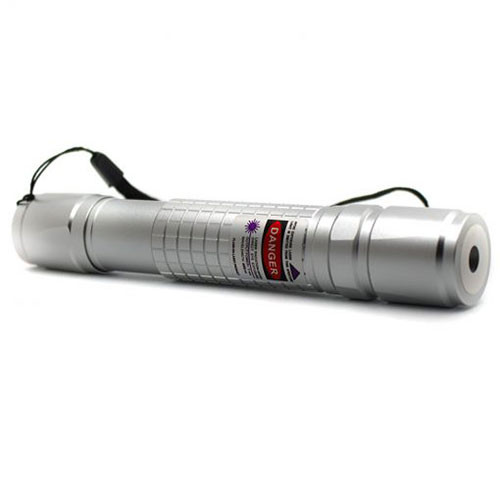
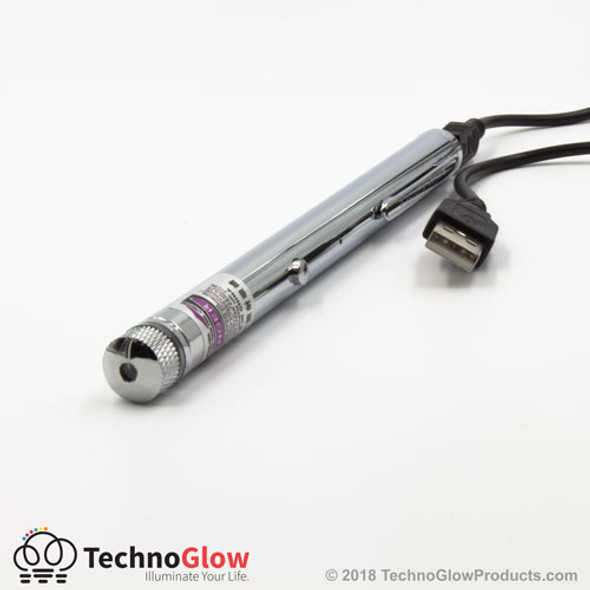
However, this article is going to focus on bulbs, known as black lights,
that are designed to primarily emit long wave ultraviolet light.
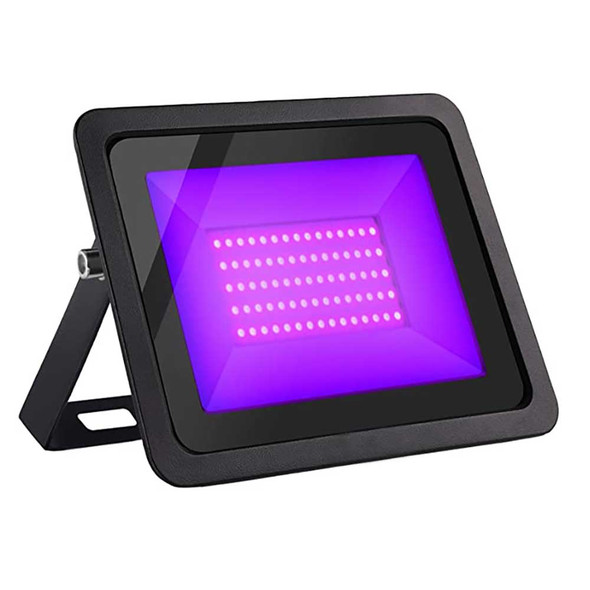
LED
The wavelength of light emitted from an LED is very
specific. When you buy an
LED, you can specify exactly what wavelength you wish it to emit.
Ideally, for black lights, you would use 365 nm LED’s.
Therefore, you would assume that manufacturers of black light products
would stick to that wavelength.
Why do they not do that?
A 365 nm LED is only about 20% efficient as a 405 nm LED.
Individual 365 nm LED's are also relatively expensive. Therefore,
manufacturers need a massive number of expensive LEDs to create a decent
LED Blacklight.
Furthermore, light from true 365 nm LED’s is not visible and
therefore uneducated consumers are not happy with the "light output".
The popular stage lighting company, Chauvet,
released a “black light” consisting of 192 “UV” LEDs.
This product is a great VIOLET light using 405 nm, visible light,
violet LED’s. However, it is
almost completely useless as a black light.
You can understand their reasoning when several DJ’s reviewed
this light as “much brighter” than more powerful fixtures emitting true
long wave ultraviolet light. The reviewers
were making this determination by how much light they could see.
Properly, they should have used fluorescent paint to determine
the best fixture.
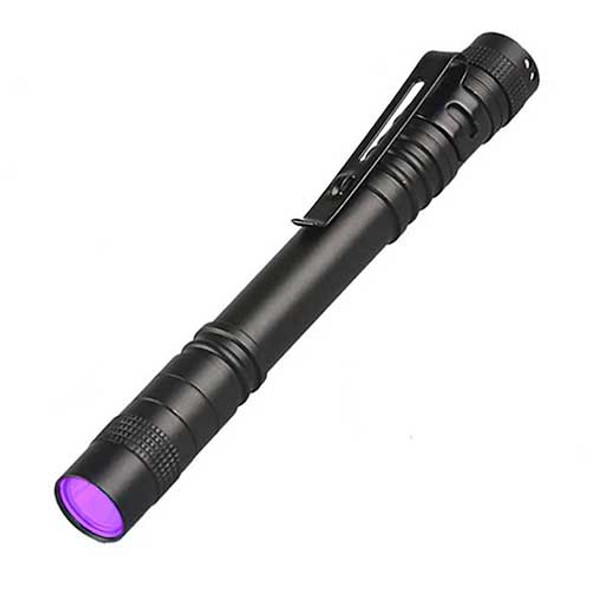
Flashlight manufacturer Inova, makes a “UV”
flashlight with 3 365 nm LED’s and 2 405 nm LED’s for the same reason.
LED’s use relatively low electricity and emit
almost no heat . They turn
on instantly and can be very bright.
They also have an extremely long bulb life.
If you select an LED fixture, you just need to make
sure that the product you are buying includes 365 nm LED’s.
Currently, LED fixtures of similar power are
10-20 times more expensive then standard fluorescent black lights.
Incandescent
Bulbs
Incandescent black lights are created by taking a
regular white light bulb and adding a coating to filter the visible
light, passing only long wave UV light.
Since less than 2% of the light is emitted as long
wave UV, they are very poor black lights.
As such, you would think they would not ever be sold.
Incandescent bulbs are popular because
they are cheap and can screw into any home fixture.
Unfortunately, they are useless for charging glow in the dark
items. In fact, they are
almost completely useless unless you want a violet light bulb.
Fluorescent
Black light and white light fluorescent
tubes are very similar.
The mercury inside of all fluorescent
tubes primarily emits UV light (long, medium and short).
For white lights, the inside of the tube is coated with fluorescent
phosphors to convert UV light to visible white light.
The glass of the tube filters any remaining medium and short wave
UV.
The phosphors in a black light
fluorescent tube convert all of the UV light to long wave UV.
For most black lights, a coating on the exterior filters any
excess visible light (above 400 nm).
The result is an extremely efficient, inexpensive black light.
Fluorescent tubes vary by both length
and thickness. Popular black
light thicknesses are T-8 (1”) and T-12 (1.5”).
Contrary to instinct, T-8 bulbs, using newer technology, are
brighter, more efficient, flicker less, and can start in colder
temperatures. Therefore,
there is no reason to buy a T-12 bulb or fixture.
Of course spectrum, brightness and quality vary by brand.
The only problem with full size fluorescent tubes as black lights
is that they are large and delicate.
Compact
Fluorescent
The new CFL (compact fluorescent) bulbs
are just miniature fluorescent tubes.
True black light versions are available and share the
characteristics of the larger tubes.
Light output and wavelength varies greatly between brands and
styles.
Black light CFL bulbs screw into a standard light
socket and typically use 25-40 watts of power.
Larger wattage units are typically sold in their own specialty fixture.
Unfortunately, the majority of CFL “black lights”
are actually regular white CFL bulbs dipped into a coating that filters
all non-violet light. Yes,
this is absurd. The mercury
inside these bulbs creates ideal UV light.
The phosphors convert the UV light to white light.
The coating filters all of the white light but violet.
Only about 4% of light makes it out of the bulb rendering it
completely useless. Yes,
companies go out of their way to make this crappy product.
HID
Several stage lighting manufacturers offer a 400
watt HID mercury black light.
They function very similar to a black light fluorescent tube.
However, they take 5-10 minutes to turn on, they get very hot,
they are very heavy, and they use a lot of electricity.
The bulbs have a short life and are relatively expensive to
replace.
These large powerful lights are sometimes preferred
because they can project ultraviolet light a far distance.
Otherwise, their drawbacks make them unappealing compared to
fluorescent and CFL fixtures.
Glow Inc.'s Black Light Fixture
The Glow Inc. fixture projects forward more long
wave ultraviolet light than seven standard 2' fluorescent black lights
using less than 1 amp of electricity . However, its all aluminum
enclosure is only 14" x 10" x 7" and weighs 11 pounds.
The fixture contains a 100 watt compact fluorescent
bulb constructed with true woods glass. Behind the bulb is two
efficient glass mirror reflectors. The bulb is protected by a
shatter proof front glass cover. The whole unit keeps cool using
convection vents.
As you can see, for its price, this is an amazing
black light fixture.
Conclusion
If you need an inexpensive black light to use with
your glow in the dark or fluorescent creations, then stick to full size
or compact fluorescent tubes.
LED fixtures are a viable, yet expensive alternative.
However, you must make sure
they incorporate 365 nm LED’s.
In general, stay clear of incandescent or HID.
A request from the author:Glow Inc. has always
been at the forefront of providing free technical information on the
subject of "glow in the dark". Most recently, we added the
Glow in the Dark Forum so that
customers can add to this free information base. However, we are in
desperate need of exposure on the Internet. If you enjoyed this
article, please consider putting a link to it on your website, blog, or
your favorite forum.
|